ofxImGuiMarkdown
Markdown preview widget for
Dear ImGui inside openFrameworks, built on top of
imgui_md and
MD4C.
Supported Markdown Features
Everything below is implemented and exercised by
example-markdownEditor:
| Category | Features |
|---|
| Structure | Paragraphs, soft-wrapped text, headers (H1–H6), horizontal rules |
| Emphasis | Bold, italic, bold+italic (nested or combined), ~~strikethrough~~, <u>underline</u> |
| Lists | Ordered and unordered lists, including nested sub-lists |
| Links | label — opens via ofLaunchBrowser; [[Page\ | label]] wiki links (styled, clickable) |
| Images |  ofImage loads (FreeImage), plus SVG preview (ofxSvg); cached; optional http(s):// URLs |
| Quotes | Block quotes with left bar and tinted text |
| Code | Inline ` code spans and fenced blocks with syntax highlighting (ofxImGuiTextEdit) |
| Tables | Resizable columns, borders, alternating row background, bold headers (stretch to panel width) |
| HTML |
, <hr>, <u>, </u>, <div class="...">, </div> (style via html_div() override) |
| Other | Backslash escapes, entity |
Word wrap uses font measurement by default. When
ofxUnicode is linked, line breaks also follow Unicode rules for the configured wrapLanguage
(default "en"
).


Not supported (yet)


These MD4C constructs are parsed by the underlying library but have empty handlers in
imgui_md
— they render as plain text or are skipped:
$...$
) and display ($$...$$
) — requires MD_FLAG_LATEXMATHSPANS
(not enabled)Task lists, spoilers, sup/sub scripts, admonitions — other optional MD4C extensions (not enabled) Raw HTML blocks beyond the tags listed above are ignored. <div class="...">
emits enter/leave callbacks but has no default styling — subclass and override html_div()
to style named classes.
Font coverage
With bundled ofxImGuiStyle fonts, all emphasis styles have a dedicated JetBrains Mono face:
| Renderer field | JetBrains Mono | Used for |
|---|
regularFont | Regular | Body text |
boldFont | Bold | Bold, table headers |
italicFont | Italic | Italic |
boldItalicFont | BoldItalic | Bold + italic (nested ……… or ………) |
monoFont | Regular | Inline and fenced code |
headingFont | Bold @ larger size | H1 (example uses 22 px) |
h2Font | optional | H2 only; when unset, H2 uses headingScale[2] |
| (H3–H6) | boldFont / regularFont | Sized by headingScale[3] … [6] |
That is full variant coverage for the bundled monospace family. It is not 100% MD4C/imgui_md feature coverage — see Not supported above.
Dependencies
| Addon | Role |
|---|
ofxImGui | ImGui integration |
ofxImGuiTextEdit | Fenced code blocks with language highlighting |
ofxUnicode | Optional — Unicode-aware line breaking in preview wrap |
ofxImGuiStyle | Optional — bundled Input Sans + JetBrains Mono (no disk font files) |
Usage
#include "ofxImGuiMarkdown.h"
include "ImFonts.h"
// --- In your ofApp class ---
ofxImGui::Gui gui;
ofxMarkdownRenderer renderer;
// --- setup() ---
ofDisableArbTex(); // before textures / gui.setup() — see Images below
gui.setup();
// Bundled fonts (ofxImGuiStyle):
if (ImFont* ui = ImFonts::LoadDefaultFonts(ImGui::GetIO().Fonts, 15.f))
gui.setDefaultFont(ui);
ImFonts::JetBrainsMonoFonts jbm = ImFonts::LoadJetBrainsMono(ImGui::GetIO().Fonts, 15.f);
renderer.regularFont = jbm.regular;
renderer.boldFont = jbm.bold;
renderer.italicFont = jbm.italic;
renderer.boldItalicFont = jbm.boldItalic;
renderer.monoFont = jbm.regular;
renderer.headingFont = ImFonts::LoadJetBrainsMonoFont(
ImGui::GetIO().Fonts, 22.f, ImFonts::JetBrainsMonoVariant::Bold);
gui.rebuildFontsTexture();
// Or load from disk via gui.addFont():
// renderer.regularFont = gui.addFont(ofToDataPath("fonts/MyRegular.ttf"), 15.0f);
// renderer.boldFont = gui.addFont(ofToDataPath("fonts/MyBold.ttf"), 15.0f);
// renderer.italicFont = gui.addFont(ofToDataPath("fonts/MyItalic.ttf"), 15.0f);
// renderer.boldItalicFont = gui.addFont(ofToDataPath("fonts/MyBoldItalic.ttf"), 15.0f);
// --- draw() ---
gui.begin();
if (ImGui::Begin("Markdown Preview")) {
renderer.render(myMarkdownString);
}
ImGui::End();
gui.end();
Convenience Free Function
For simple cases without custom fonts, use the free function which keeps a shared static renderer:
gui.begin();
if (ImGui::Begin("Preview")) {
ofxRenderMarkdown(markdownText);
}
ImGui::End();
gui.end();
Images
Inline images use the same loaders as openFrameworks itself — not a hand-picked subset.
Raster — anything ofImage
can read via FreeImage, including:
| Common | Also supported |
|---|
PNG (.png) | BMP, ICO, TIFF (.tif/.tiff), TGA |
JPEG (.jpg, .jpeg) | GIF (first frame), PSD, PPM/PGM/PBM |
| EXR, HDR, DDS, WBMP, PCX, SGI, JP2, … |
Format detection is by file content and extension (FreeImage), so extensionless paths still work when the file is readable.
Vector — SVG (.svg
) is rasterised through ofxSvg into an off-screen FBO at svgScale
(default 2.0
) for crisp preview in ImGui. This is separate from ofImage
 because openFrameworks does not load SVG as a bitmap natively.


Paths — resolved in order: path as written (relative to the app’s working directory, usually
bin/
), then ofToDataPath()
. Example: data/photo.tiff
or photo.tiff
in bin/data/
.


Remote —
http://
and https://
URLs work for raster images (ofImage
 network load). SVG URLs are not fetched automatically.


Images are loaded on first encounter and cached for the lifetime of the renderer. Call
renderer.clearImageCache()
 after a GL context rebuild or to force a reload.


Failed loads are skipped silently (no broken-image placeholder). Check the verbose log for
"Image not loaded:"
 messages.


Important: ARB textures must be disabled before images are loaded so that texture coordinates are normalised to 0–1 (as ImGui requires). Call
ofDisableArbTex()
once in setup()
before gui.setup()
:


void ofApp::setup() {
    ofDisableArbTex();
    gui.setup();
    // ...
}


To cap display width (aspect ratio preserved):


renderer.maxImageWidth = 400.0f; // pixels; 0 = auto-fit to window width


For sharper SVG on HiDPI displays:


renderer.svgScale = 2.0f; // 1.0 = native SVG units, 2.0 = 2× supersampling


To customise loading (URLs, tint, placeholders), subclass
ofxMarkdownRenderer
and override get_image()
:


struct MyRenderer : public ofxMarkdownRenderer {
    bool get_image(image_info& nfo) const override {
        // m_href contains the image path/URL from the markdown source
        nfo.texture_id = (ImTextureID)(uintptr_t)myTexture.getTextureData().textureID;
        nfo.size       = { 200, 150 };
        nfo.uv0        = { 0.0f, 0.0f };
        nfo.uv1        = { 1.0f, 1.0f };
        nfo.col_tint   = { 1.0f, 1.0f, 1.0f, 1.0f };
        nfo.col_border = { 0.0f, 0.0f, 0.0f, 0.0f };
        return true;
    }
};


Wiki links


MD4C wiki-link syntax is enabled:
[[Page]]
, [[Page|label]]
, [[path/to/Page]]
, [[https://example.com|Example]]
, and [[#anchor]]
.


Wiki links use the same link styling as
text (colour, underline, tooltip showing the target). On click:
- Regular markdown links — always open in the system browser via
ofLaunchBrowser
.Wiki links — call onWikiLinkClicked
when set; otherwise URL-like targets open in the browser and local page names are resolved with resolveWikiPagePath()
 (logged if no handler is installed). renderer.wikiLinkBasePath = ofToDataPath("", true); // bare "Notes" -> data/Notes.md

renderer.onWikiLinkClicked = [&renderer](const std::string& target) {
    const std::string path = renderer.resolveWikiPagePath(target);
    if (!path.empty() && ofFile::doesFileExist(path))
        loadMarkdownFile(path);
    else if (target.find("://") != std::string::npos)
        ofLaunchBrowser(target);
};
example-markdownEditor
loads data/README.md
when you click [[README|README]]
.


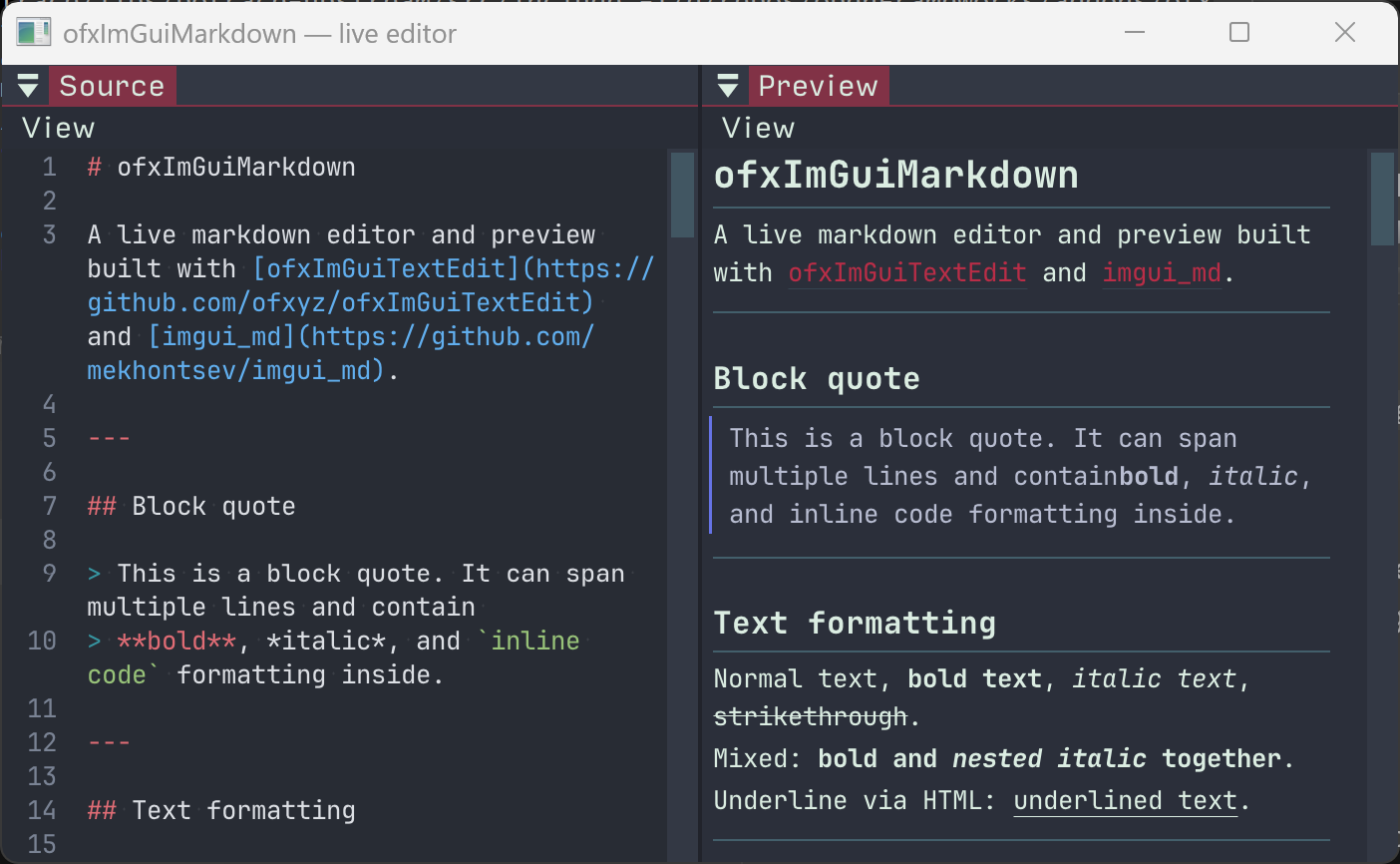
Example
example-markdownEditor
— a docked live editor/preview split using ofxImGuiTextEdit
(Markdown language, soft wrap) on the left and ofxMarkdownRenderer
 on the right. Edit markdown source and see the rendered output update in real time.


Requires
ofxImGui
, ofxImGuiTextEdit
, ofxImGuiStyle
, ofxSvg
, and optionally ofxUnicode
in addons.make
.
Vendored Libraries
| Library | Source | License |
|---|
| imgui_md | libs/imgui_md/src/ | MIT |
| MD4C | libs/md4c/src/` | MIT |
 ofxAddons
