 ofxAddons


openFrameworks addon for ortho — invented-language generator
README
ofxOrtho

openFrameworks addon for ortho, an invented-language generator — pseudo-words that hold the shape and internal consistency of a language without belonging to any existing one.
One instance mints a language substrate once from a seed (its own consonants, vowels, digraphs, trigraphs, contractions), then every word comes from that same invented tongue. Output holds together as one language rather than a fresh scramble. Names recur, phrases return whole, things get quoted.
Same seed → same language, on every host and every run.
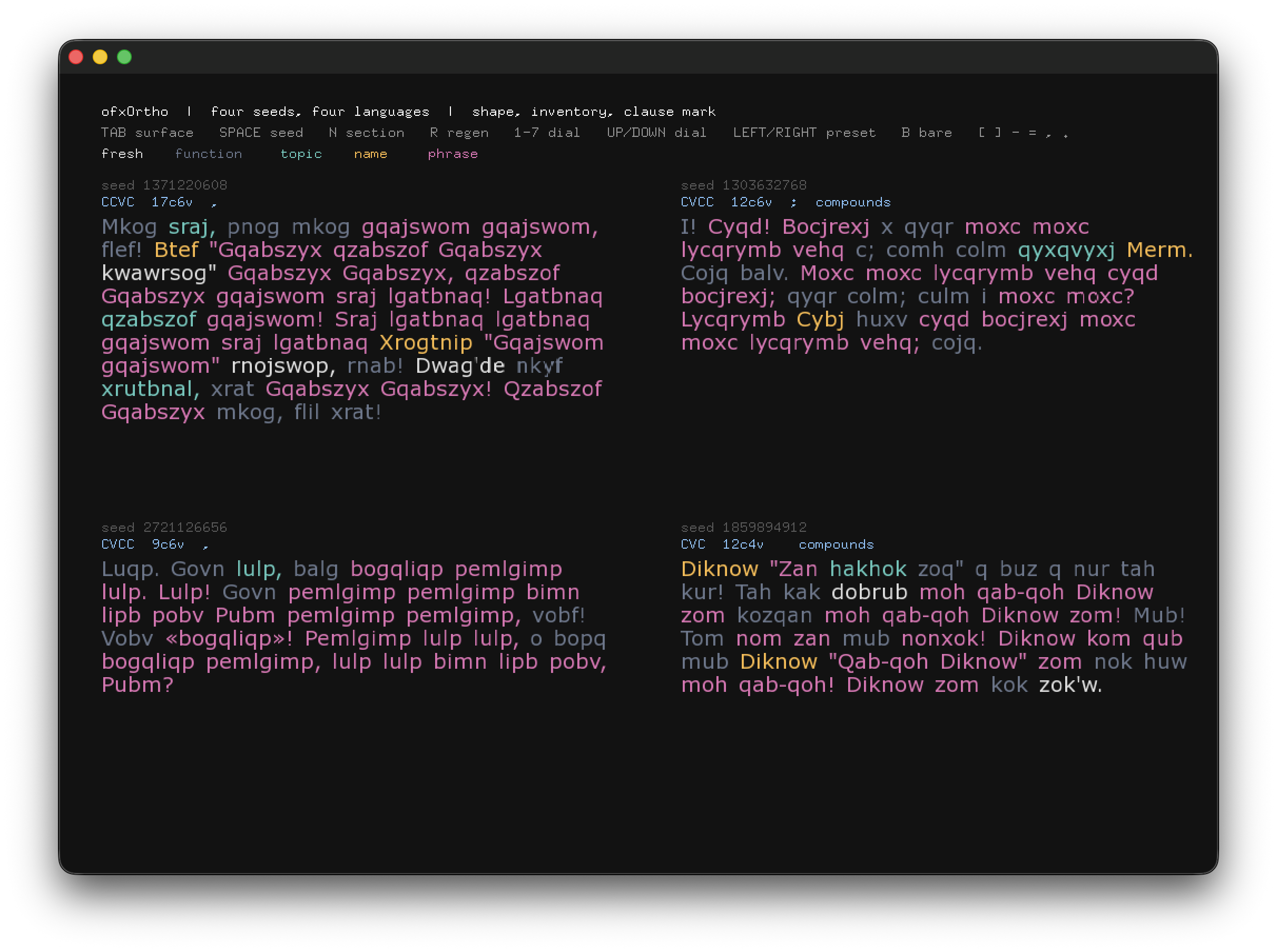
Tokens coloured by origin: names, topics, and recurring phrases are distinguishable from fresh coinages, on both the neutral and readable paths.
Install
cd openFrameworks/addons
git clone https://github.com/leeMeredith/ofxOrtho.git
Or use GitHub's Download ZIP. The language engine is vendored into
libs/ortho-kernel/, so both routes work with no extra steps.Then generate a project with Project Generator and check ofxOrtho.
Usage
ofxOrtho ortho;

ortho.setup(12345);              // seed names the language
ortho.setPreset(0.5);            // one-knob onramp

auto words = ortho.tokens(100);  // vector<string>
Tokens carry their origin, which is useful for visual work — colour by source, animate names differently, spawn on NAME:
for (auto &t : ortho.tokensWithSource(100)) {
    switch (t.source) {
        case ORTHO_SRC_NAME:   / section's identities / break;
        case ORTHO_SRC_TOPIC:  / section's subject    / break;
        case ORTHO_SRC_PHRASE: / recurring phrase     / break;
    }
}
The seven dials
Each takes a double in
[0,1], default 0. Frozen vocabulary — the same names appear as JS options, Max attributes, and oF setters.| setter | effect |
|---|---|
setPhrases() | multi-word phrase recurrence, atomic |
setFunctionWords() | grammar-glue recurrence, document scope |
setTopics() | the section's subject recurring, section scope |
setNames() | the section's identities recurring, section scope |
setCommas() | narrative pacing (readable path only) |
setQuotation() | direct-speech span (readable path only) |
setScareQuotes() | a single term held at arm's length |
setPreset(), regardless of call order:ortho.setTopics(0.9);
ortho.setPreset(0.3); // topics stays at 0.9With all seven at zero the engine reproduces the bare golden vectors exactly.
What makes one language differ from another
Every seed draws its own phonology, not just its own vocabulary:
- A root shape.
CVCV,CCVC,CVCC,CVVand others. This is the shape
CVCV language has no consonant clusters at all — like Hawaiian; a CCVC language is full of them. - A phoneme inventory. Between 6 and 20 consonants, 4 to 6 vowels. Hawaiian
- Letter frequencies. Weighted per seed, and compensated against inventory
- Its own clusters. Consonant digraphs and trigraphs, and vowel digraphs for
CVV shapes, all drawn from the language's own inventory. - Punctuation. A clause mark (
,;:or an em dash), a quote pair,
Quote pairs are drawn from
" ", « », and ‹ ›. The last two are guillemets — the standard quotation marks in French, Russian, Spanish and many other languages. A language that quotes with guillemets reads as foreign before you have parsed a word of it, which is the point. If you want ASCII quotes for a particular piece, pick a seed that has them.Note that guillemets and the em dash are multibyte UTF-8.
ofDrawBitmapString is ASCII-only and draws nothing for them while still advancing — use ofTrueTypeFont with the full character set, as example-basic does. - Compounding and particles. Some languages join roots with a hyphen; all
Length arguments are ceilings, not targets
maxLetters and maxWords cap a random draw rather than setting it. Word lengths vary below the value, which is deliberate — uniform lengths read as a list rather than as prose. Word length is rounded up to a whole number of roots, so a CVCV language produces 4- and 8-letter words rather than truncations.Spec 1.x and 2.x had
paragraph() draw below both arguments before calling sentence(), which reduced word length twice and left paragraphs at two or three letters. Fixed in 3.0: maxWords is drawn below, maxLetters is passed through.Sections
newSection() mints a fresh cast of names, topics, and phrases. Same language, new subjects.Reproducible or random, both
A seed names a language, so you get both surprise and recall:
uint32_t seed = ofRandom(0, UINT32_MAX);
ortho.setup(seed);       // a language you've never seen
                         // keep the number and you can always return to it
Surfaces
| call | returns |
|---|---|
tokens(n, maxLetters) | exactly n words, no punctuation |
tokensWithSource(n, maxLetters) | same, each carrying its origin |
sentence(numWords, maxLetters) | capitalised, terminal mark, punctuation per dials |
paragraph(numSentences, ...) | several sentences flattened |
word(numLetters) | one word |
tokens() is count-exact and never punctuated — it is the harness contract and the vector-diff path. sentence()/paragraph() are the readable path.Design rule
The wrapper performs translation, not interpretation.
Its only job is converting between
ortho_token[] and C++ types, and exposing the dials. Every public method maps to exactly one kernel concept. If this addon starts making language decisions, something has gone wrong — that logic belongs in the kernel, where every host shares it.Conformance
Coherence across hosts is proven, not hoped for:
./tests/conformance.sh ../orthoCONFORMANT — 7/7 vectors, spec 1.1, vectors v2The oracle drives this wrapper (not the kernel directly) and diffs its output against the reference repo's golden vectors — identical text and identical source classification. It builds standalone with plain
cc/c++; no openFrameworks required, because building GLFW proves nothing about language conformance.Run it from the addon root, with the
ortho reference repo as a sibling directory. CI runs it on macOS and Linux on every push — that is what the badge above reports.The constellation
ortho— JavaScript reference,SPEC.md, golden vectors. The authority.ortho-kernel— the shared host-neutral C engine, vendored here at commit2ba6491(seelibs/ortho-kernel/VENDORED.md)ofxOrtho(this repo) — openFrameworks addonortho-max— Max/MSP external
Platforms
Tested: openFrameworks 0.12.1 on macOS (Apple Silicon), Xcode clang. C++11 or later.
Untested but expected to work: Linux, Windows, iOS, and other oF targets. There is nothing platform-specific in this addon - the kernel is plain C99 with zero dependencies and zero allocation, and the wrapper uses only the C++ standard library. No OS APIs, no threads, no file I/O, no third-party libraries.
If you build it somewhere I haven't, I'd welcome an issue or PR either way. The conformance harness is the useful thing to run first, since it compiles with plain cc/c++ and needs no openFrameworks. If it reports 7/7 on your platform, the language layer is sound there and any remaining problem is in the oF build, not the engine.
Credit and licensing
Every part of the stack is MIT, and all of it is my own work:
ofxOrtho(this addon) — MITortho-kernel— the bundled C
libs/ortho-kernel/ — MIT ortho— the JavaScript reference and
The addon has no third-party dependencies. The kernel is plain C99 with zero dependencies and zero allocation; the wrapper adds only the C++ standard library. Nothing beyond openFrameworks itself is pulled in.
License
MIT — see LICENSE.